

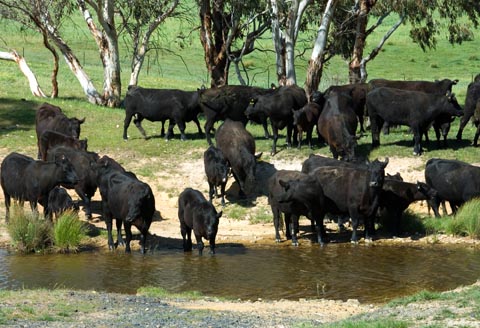
If you remember (Courageous Love), Mitch’s precious Angus heifers started dying in his special pasture. How were they poisoned? Someone had dumped baking soda into their water, causing a reaction in one of the heifers’ stomachs (cows have four stomachs, in case you didn’t know this). Anyway, learn about the wind pump that brought the water to the tank and also learn how those poor heifers ended up in such dire straits.
See more Blasts from the Past >>
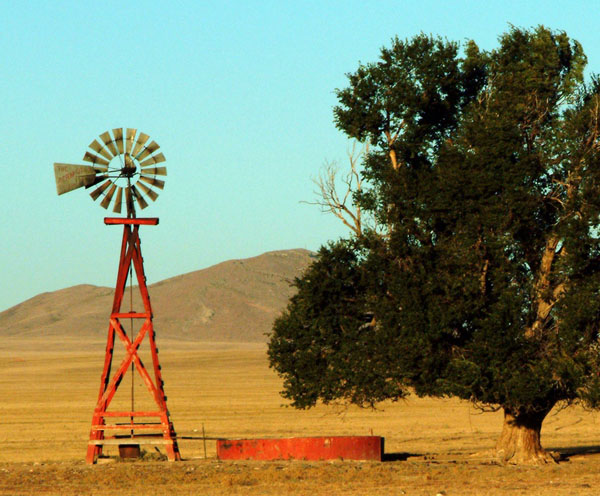
Windmills have been around ever since people figured out how to harness the wind’s energy for various purposes. A windmill can be used to grind grain, pump water, or create electricity. The windmill on the Circle C ranch is actually called a wind pump. It is used exclusively for bringing up water from an underground well for livestock to drink. Daniel Hallady invented this type of wind pump in 1854, and its use quickly spread all across rural America.
Watch this 50-second video of an old, 1910 wind pump using the wind to draw water up from underground.
How does a wind pump work?
If you watched the video, you probably figured it out already. But here’s the quick “how-to” version.
- The top part of the wind pump (the vanes) turns freely so it can catch the wind no matter which direction it blows. On a breezy day, the vanes spin continuously.
- The blade apparatus connects to a set of gears that makes a rod go up and down. This long rod extends deep underground and is attached to a pump inside the well.
- Cylinders with pistons and one-way flaps allow the water to be pulled to the surface and discharged into a holding tank without falling back into the well.
Acid and alkali
Andi’s brothers drained the stock tank to flush out the alkali that poisoned Mitch’s heifers. To show how dangerous a high concentration of alkali in the water is to cattle, do this experiment. What happens when ACID (like inside a cow’s stomach) combines with ALKALI (baking soda)? You need:
- 2 tablespoons baking soda
- 1/2 cup water
- 1/2 cup vinegar
- a large glass bowl
Mix the baking soda and water until it dissolves. Pour into a large glass bowl. Slowly add part of the vinegar to the soda water. What happens? When the reaction stops, add more vinegar. What keeps happening? Why was this bad for the heifers?
The reaction that occurs inside the cow’s acidic stomach has devastating results. The gas bubbles created by the chemical reaction cause the cow to bloat and to belch. This brings up the stomach’s contents, which burn the heifer’s throat. The contents can also seep into the cow’s airway. If it is not caught early enough, death follows. Pouring grease down the cow’s throat coats the lining of the throat and helps prevent the acid burns.

 Andi Carter's Blog
This is neat to know!!
LikeLike
Oh wow! That is very interesting!
LikeLike
That’s super cool! 😀
Thank you for sharing this post, Mrs. M! 😀
LikeLike
That’s really neat!
LikeLike
Nice! that’s so neat! great to know!
LikeLike
Cool!
LikeLike