- See more of Andi’s Guest Bloggers >>
- See more “Horses” Posts >>
Guest Blogger Allie Lynn
Allie Lynn is a passionate and talented writer who first and foremost desires to honor God with her writing. She has been passionate about “all things horses” from a very young age, which greatly influences her work. Her desire is to produce equine-based fiction that is inspiring and entertaining without compromising her faith. When she is not diving into her fictional world, she is writing articles and short stories for magazines and websites. You can follow Allie Lynn’s work at EquineontheMind.com
Mustangs!
The word “mustang” comes from the Spanish word mesteno, which means “feral.” Makes sense, because mustangs used to be the horses of Spanish soldiers, now gone wild.
Many of the horses still have that Spanish influence, especially in their heads. Most Spanish horses have what’s called a “barb” head– really just a fancy word for a roman nose.


Spanish Colonial Horse
There are so many different types of mustangs, and all of them are so beautiful! And they all descend from one breed: the Spanish Colonial Mustang.
Spanish Colonial Mustangs are believed to be the first Spanish horses whose influence is now all over the mustang herds. They are the state horse of North Carolina and are considered the purest of Spanish blood. They come in hundreds of colors and stand 13-15 hands. They are all over the southeast– even Florida has wild horses!
Pryor Mountain Mustangs
Pryor Mountain mustangs are said to be the most intelligent and hardy of the mustangs. They are also the easiest to train and legendary for their endurance and stamina. They live in the Pryor Mountain range in between Wyoming and Montana and stand 15 hands on average. Almost every color (except spotted) can be found in Pryor Mountain Mustangs
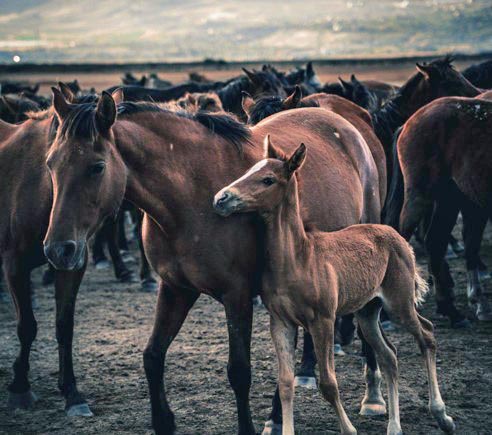

Cerbats
Cerbats are fine-boned mustangs from Arizona. They come in bay, roan, and chestnut, and stand about 14 hands. They are actually born with an ambling gait, and they are surefooted and calm. Many of them are gentled to make family horses.
Kiger Mustang
These mustangs live in southern Oregon and come mainly in dun and buckskin, with some bays, pintos, and blacks. Legend has it that Christopher Columbus brought Andalusian horses to America, but his soldiers traded them for small, hardy Sorraria horses from South America. Kigers have both Andalusian and Sorraria bloodlines.


Chincoteague Pony
The east coast from Virginia to Florida has a surprising amount of wild ponies. The most famous, of course, is the Chincoteague pony. They live on the island of Assateague, but because they are sold on the smaller island of Chincoteague, they are called “Chincoteague” ponies. These ponies come in mostly chestnut, black, bay, palomino, and pinto colors, and measure 10 to 14 hands. They live in the salt marshes and are rounded up every summer for the foals to be auctioned off. All of the profit goes to help the fire department
Shackleford Banker Pony
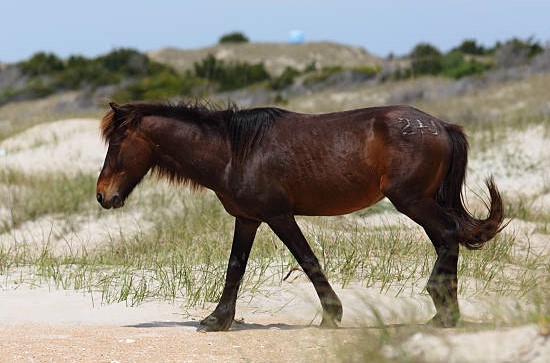
The Shackleford Banker Pony lives on the outer banks of North Carolina. They come in brown, bay, and chestnut, and stand 13-14 hands. They are small, friendly horses that will often come up to campsites looking for treats. There have been stories of Banker ponies pilfering food from campers.

Cumberland Island Horse
These ponies live on Cumberland Island in Georgia, but unlike the previous two, they aren’t doing as well. Mares don’t stick together very long, often bouncing between herds, and foals have a high mortality rate due to heat and poor food conditions. The sad life average for these horses is 9-10 years, often dying of sand colic or West Nile Virus. Efforts are being made to save the breed through captive breeding. They can be any solid colors and stand about 15 hands.
Florida Cracker Horse
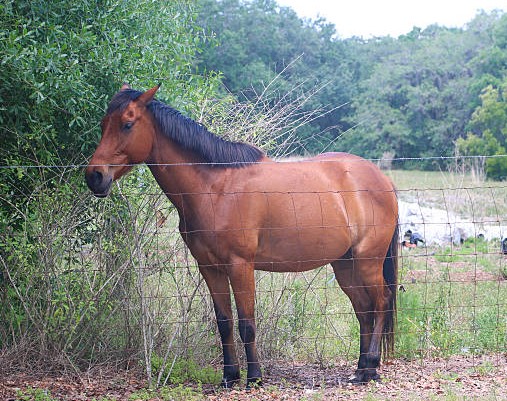
Florida Crackers, otherwise known as Marsh Tackies, Florida Cow Ponies, Chickasaw Pony, and Seminole Pony, probably rank among Chincoteagues in prolificacy. These small, beautiful Spanish horses were once used to drive the small Cracker cattle in Florida, until the beef industry demanded larger cows and thus, larger horses. The 13-15 hand Cracker was almost forgotten until the late twentieth century, when people began to conserve this breed. Today there are a little over 1,000 horses. They mostly come in gray, but they can be any color. They are mostly found in the Ocala region of Florida, and were voted the state horse in 2008.
There are many more beautiful wild horses around the world, but these are the ones that you’ll be most likely see in America. Maybe one day you’ll take a trip around the US and visit all of them! Which one is your favorite? Feel free to comment on which horse you think you would love to have as your very own!

 Andi Carter's Blog
Wow! It looks so amazing. (I was literally stalking my email for this post LOL). Thank you again, Mrs. Marlow!
LikeLiked by 4 people
Super cool post!!!! 😀
LikeLike
I don’t know why my name is Anonymous… its Sara M just so y’all know! lol
LikeLiked by 1 person
Awesome post, thanks Allie Lynn!! If I could own one of these horses it’d probably be the Cerbats but they all are gorgeous!
LikeLike
Awesome post Allie!
LikeLike
@Allielynn I love your blog! Its sooooooo cool! And I am sooooo happy that u try to make it a safe blog!
LikeLiked by 2 people
Thank you! Yeah, it was something I always wanted when I was younger… so now here I am!
LikeLike
Allie, You did an amazing job on this post! You are so talented! Great job! I loved reading it!
Hmm… if I could choose a horse it would be from the Mustangs.
@Allie Lynn which would you like to have as your own?
LikeLiked by 1 person
I’m a Pryor Mountain mustang girl, because my first introduction to mustangs was through a YT video on PMs. I also LOVE Chincoteagues. There’s another wild horse breed I didn’t mention because it’s so small, but in Eminence, Missouri, there is a small, 30 head herd of wild horses. I would probably want to own one of those.
LikeLike
JUST ANOTHER NOTE: If you guys would like to stay on top of more articles like this, you can subscribe to my blog. You also get a free ebook when you subscribe. I’m super close to getting 50 subscribers and my goal this summer is to get 100 subscribers.
LikeLiked by 1 person
I offer a giveaway when I hit my subscriber goals
100- 1 prize , 1 winner
200- 2 prizes, 2 winners
300- 3 prizes, 3 winners (that was pricey lol)
Now I’m almost to 400. Yes! 4 prizes to 4 winners! Crazy!
LikeLiked by 2 people
That’s a really smart idea! I should try that…
LikeLike
My favorite would have to be the Kiger Mustangs, because my family got to live on a ranch with seven of them for a period of time. They were only a few generations from wild!
Good job, Allie Lynn!
LikeLike
Fun fact, the movie horse, Spirit, was inspired by a Kiger mustang stallion
LikeLike
More fun fact. The live inspiration for Spirit is retired on a horse refuge in southern CA, and my Circle C audio books narrator had visited and knows the owners. So she has seen the real Spirit!
LikeLiked by 2 people
That’s so cool!
LikeLike
I grew up watching that movie.
LikeLike
My dad sometimes sees wild mustangs when he runs in the foothills!
LikeLike
I saw a photo of the original Spirit in an article. I think he’s like… 28 now?
LikeLike
I actually have no idea. 😉
LikeLike
*googles it* 26! He’s a gorgeous stud…
LikeLike
Here is the Return to Freedom Horse Sanctuary, where Spirit lives now.
https://returntofreedom.org/
LikeLike
And here is the direct link to “meet” Spirit
https://returntofreedom.org/what-we-do/sanctuary/our-horses/spirit/
LikeLike
Oh my gosh! I didn’t know that Spirit was a real horse! 😍
LikeLiked by 2 people
YAY ALLY!!!! I’M SO PROUD OF YOU GIRLIE!!!
LikeLike
I’ve always watned to see the Cerebats, but I’ve never gotten lucky.
LikeLike
I looove mustangs. so sad they are being killed for meat. Spirit is one of my fav movies! I have books about the mustangs. lol
LikeLike